Course modules
A guided syllabus for visitors, investors, research collaborators, government reviewers, and technical users.
Free ecosystem course
This course explains how TalkToAI, ZeroThink, ZeroThink CLI, OpenZero, TalkToAI fine-tuned LLMs, ZMath encryption, ZSEC, DNA Lab, Cymatics, FreeWebPanel, FrontDeskAgent, World SEO Service, and QuantumEncryption1 fit together. Learn the workflow, discover your best path, then take an optional exam and generate a local browser certificate.
Ecosystem map
A practical understanding of which tool to use, how to connect your own local LLM, and how to explain the ecosystem to technical reviewers.
Executive PDF and animated reader
The new TalkToAI Ecosystem Guide starts with five pages styled for investors, UKRI and public-sector/technical reviewers, professors, and university students. After that it switches into plain one-page outlines for average users, developers, server operators, businesses, researchers, and content creators.
The PDF is static for reliable download and print. The animated version lives online, where scroll effects and motion work properly across modern browsers.
Course briefing pack
This course-specific pack is written for students, reviewers, educators, teams, and technical readers. It explains the learning path, the audience fit, the certificate boundary, and why a public course makes the wider TalkToAI stack easier to trust and adopt.
The online reader carries the animation and motion. The PDF is static, clean, and ready to forward or print.
Watch first
Start with the video if you want the full map before reading the modules. It introduces the main tools, where each one fits, and how the ecosystem moves from browser AI to self-hosted infrastructure and secure deployment.
What you will learn
You will learn the front door of the ecosystem, the self-hosting path, the research paper workflow, how OpenZero can generate API keys, how to connect those keys to ZeroThink or another website, and where ZMath, ZSEC, DNA Lab, Cymatics, FreeWebPanel, QuantumEncryption1 and the business services sit.
A guided syllabus for visitors, investors, research collaborators, government reviewers, and technical users.
Public fine-tuned model releases sit alongside newer research moving through ZeroThink, OpenZero, and related systems.
The exam is optional. Passing creates a browser-generated TalkToAI Ecosystem Certificate of Completion.
Progress and certificate generation stay in the visitor browser. No login, no signup, no tracking database.
TalkToAI model library
The public Hugging Face presence includes more than 20 TalkToAI research-tuned model releases, with newer research continuing inside ZeroThink, OpenZero, ZMath and associated tools. The course teaches how to use hosted models, local OpenZero models, external API models, and your own model endpoints without mixing up what each lane is responsible for.
Syllabus overview
Mark modules complete as you read. The page stores progress locally in your browser so you can return later on the same device.
Course cockpit
Complete modules as you go. The page will build a local progress record, then the exam can create a downloadable certificate when you are ready.
Understand the relationship between TalkToAI, ZeroThink, OpenZero, ZMath, ZSEC, DNA Lab, Cymatics, FreeWebPanel, FrontDeskAgent, World SEO Service and QuantumEncryption1.
Use ZeroThink as the browser workspace for reasoning, research, model selection, library material, quantum lanes, and local-node routing.
Learn when to use the CLI for local files, server work, research evidence, surveys, paper drafting, and operator-style workflows.
Build an evidence plan, upload or reference source files where enabled, understand the source ledger, and separate retrieved evidence from LLM-written synthesis.
Install a local-first AI server, run CPU-friendly model lanes, use Ollama/Gemma/BitNet-style workflows, and operate without depending only on external providers.
Understand the Hugging Face model library, fine-tuned TalkToAI research releases, hosted model lanes, local model lanes, and how new research enters ZeroThink and OpenZero.
Generate keys from OpenZero, connect them into ZeroThink Neural Vault or another website/server, and understand the responsibilities before selling API access to others.
Learn the dual-key concept, pattern-image material, file containers, ZME1/ZEQ-style language, and why security claims must stay testable and bounded.
Understand the enterprise and government-facing lane: ZMath files, IonQ seal evidence, UK-controlled access review, hardware integration, and provenance language.
Use ZSEC as the open-source security update lane for Linux patch awareness, safer maintenance routines, and operational hygiene.
Understand research-style tools that accept user material, create structured outputs, and require clear uncertainty notes rather than medical or physics overclaims.
Learn the hosting-control layer used to publish websites, manage domains, mail, SQL, files, server updates, and project infrastructure.
Understand FrontDeskAgent, World SEO Service, GitHub, Hugging Face, YouTube, ResearchGate, LinkedIn, documentation and public demos as proof points.
Prepare a clear explanation for enterprise, UKRI, public-sector/technical, university, investor, or partner review without overstating accreditation, security certification, health claims, or quantum claims.
TalkToAI Quiz
Answer a few quick questions and the course will recommend the strongest place to focus first. The result is not stored on a server; it stays in your browser.
Interactive labs
These labs show the most important user journeys: use the hosted studio, bring your own local model server, then protect or publish work.
Open ZeroThink, choose a model lane, add your prompt, and keep source material clear. Use the paper creator when the task needs a source ledger and evidence plan.
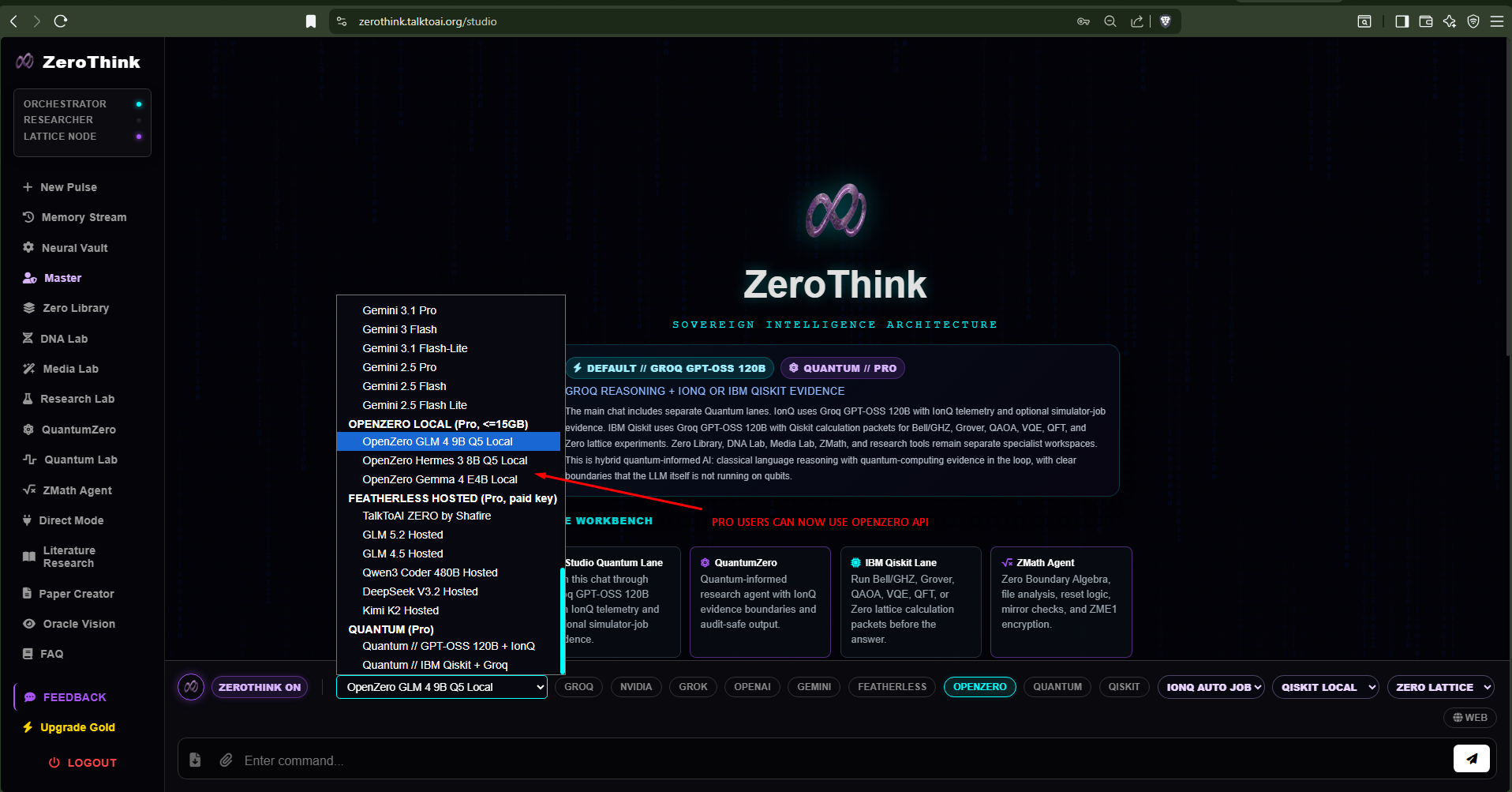
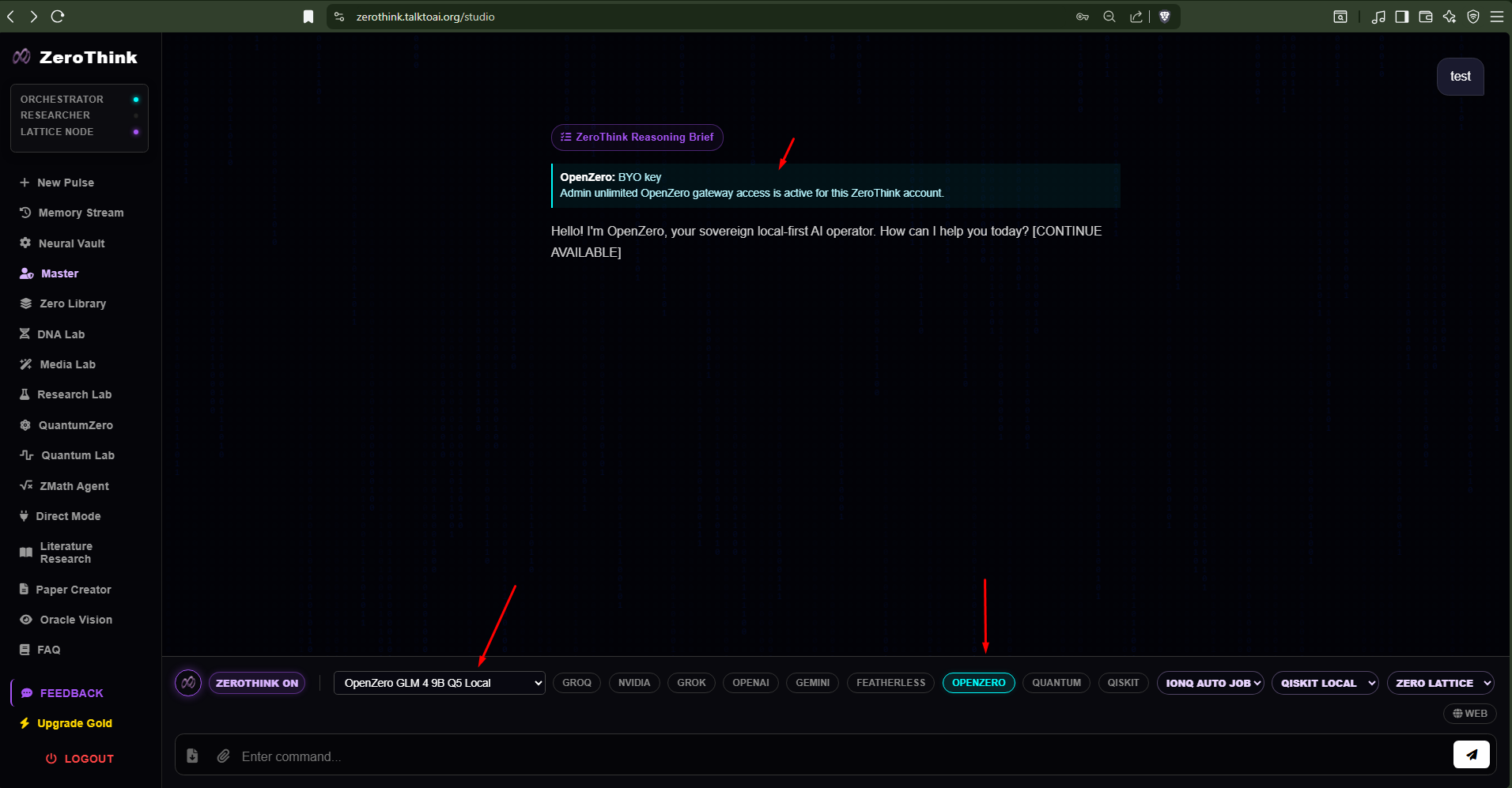
Install OpenZero on your own server, run local model lanes, create an OpenAI-compatible API key, and paste that key into ZeroThink Neural Vault or your own app.
Use FreeWebPanel for websites and infrastructure, ZSEC for update discipline, ZMath for file protection, and QuantumEncryption1 for high-assurance programmes.
OpenZero can act like a private AI company inside your own server. It can expose an OpenAI-compatible API endpoint and issue keys you control. Those keys can be used by ZeroThink, your own website, internal tools, or customer systems if you add billing, rate limits, logging, abuse controls, and clear terms.
Do not expose private keys in frontend code. Browser BYOK is for the visitor's own key and should stay local to their browser.
Visual reference
These images help visitors recognise the learning route and the products as one connected system.

Quantum and security lane
QuantumEncryption1, ZMath, ZeroThink Quantum, and related security material should be reviewed as controlled technical routes with clear evidence, limitations, and protected scoping. Public pages should teach the direction without exposing private implementation details or relying on company-registration imagery.
Evidence and safety
The course deliberately avoids hype that would confuse reviewers. It explains what is implemented, what is experimental, what requires external APIs, and what must be independently verified.
A source ledger should represent retrieved papers, uploaded files, local library items, or configured search results. The LLM can help organise and draft around those sources, but users should verify every citation before publication.
DNA, Cymatics, frequency, quantum, and mathematical tools are presented as research or analysis tools. They are not medical treatment, cure, diagnosis, or guaranteed physics proof.
Private API keys should stay server-side or in the visitor's local browser when using BYOK. Public pages should never hard-code private keys or expose server credentials.
For UKRI, enterprise and technical reviewers: this course is a product orientation and technical overview. It is not a public claim of government endorsement, formal accreditation, or security certification. Sensitive access is reviewed separately.
Optional exam
The exam is free and runs entirely in your browser. A passing score creates a downloadable certificate image or SVG document with your name, score, date and local certificate serial.
Featured ecosystem video
Watch the full walkthrough of the TalkToAI ecosystem: ZeroThink, OpenZero, local-first AI infrastructure, research direction, and the practical stack being built for builders, businesses, universities, and serious operators.