Mobile web app (PWA)
Works on Android Chrome and iPhone Safari. Add to Home Screen for a full-screen icon. OpenZero, AgentZero, ZMail and CallChat — install tips included in the app.
Launch ZERO ONE Mobile →DESKTOP · ANDROID · IPHONE · v7.9.2 / mobile 0.4.1
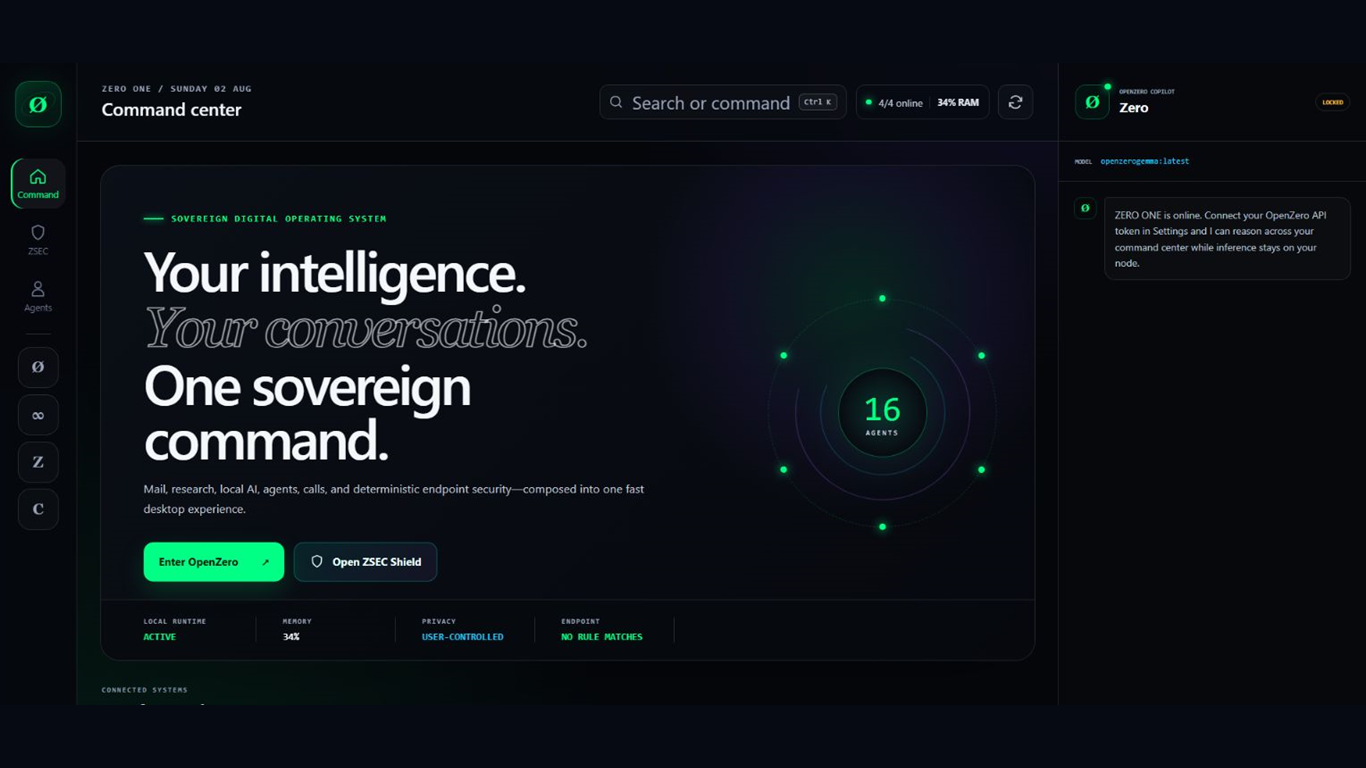
ZERO ONE unifies OpenZero, AgentZero, ZMail and CallChat. Install on your computer, or open the mobile app on Android and iPhone (installable PWA + native shells).
MOBILE · ANDROID & IPHONE
Open the progressive web app instantly, install to Home Screen, or use the native Android / iOS Capacitor shells from source and CI builds.
Works on Android Chrome and iPhone Safari. Add to Home Screen for a full-screen icon. OpenZero, AgentZero, ZMail and CallChat — install tips included in the app.
Launch ZERO ONE Mobile →Signed sideload APK and Play .aab are published with each release. Prefer the latest APK alias for auto-updaters. Source: ResearchForumOnline/ZERO-ONE-Mobile.
Download Android APK (sideload) ↓Android note: the APK is cryptographically signed for sideloading, but it is not distributed or reviewed by Google Play. Prefer the PWA install for most users. iPhone tip: Safari → Share → Add to Home Screen.
DESKTOP · VERSION 7.9.2
No terminal required. Keep opened workspaces alive while switching services, use the built-in permission-gated Browser Pilot, install verified updates from Settings, run the lightweight OpenZero Gemma4 E2B local Assistant, connect the separate Ministral 8B full OpenZero runtime, check the inbox already visible in ZMail, use the isolated one-time zSign handoff, and access the bundled ZSEC Shield.
One-click current-user installer with Start Menu and desktop shortcuts.
Download EXE ↓DMG for M1, M2, M3, M4 and newer Apple-silicon Macs.
Download DMG ↓Portable AppImage or native Debian/Ubuntu package.
Download AppImage ↓Model separation: Desktop 7.9.2 uses OpenZero Gemma4 E2B Agentic Q4_K_M for responsive local Assistant chat. The separate OpenZero Ministral 8B Runtime Agent remains the full OpenZero operator default. Quality-rejected Qwen3 1.7B and Fusion variants are blocked from the current local selector. Local chat cannot operate tools by itself; full OpenZero and both browser pilots remain permission-gated surfaces. Unsigned-package notice: Windows SmartScreen or macOS Gatekeeper may warn until signing ships. Prefer the GitHub release and verify SHA-256 checksums.
Tap into OpenZero, AgentZero, ZMail and CallChat without juggling four bookmarks.
Desktop 7.9.2 uses Gemma4 E2B for responsive local chat while the separate full OpenZero runtime keeps Ministral 8B. Resource profiles, one-chat-at-a-time safeguards and an all-OpenZero-model unload control help prevent runaway local model use.
The built-in isolated Browser Pilot needs no extension. It receives one bounded task, omits form values, blocks password, payment, secret, file and CAPTCHA handling, pauses on consequential or cross-site steps, and includes an always-visible stop control.
A visible update control in ZERO ONE checks the official stable GitHub release, verifies both its API digest and SHA256SUMS entry, then asks before installing the exact package for this operating system.
Desktop and mobile shells are Apache-2.0. Security contracts and packaging locks are public.
SECURITY BOUNDARY
HTTPS for remote services, origin allowlists on desktop, OS credential storage for desktop tokens. ZSEC folder scanning is a desktop feature. No product can guarantee detection of every threat — keep your OS protections enabled.